

Some days it feels like every time we login to Meta Ads Manager, something has changed. Sometimes these changes are irritating as hell, but every now and then, something wonderful happens.
What side Meta’s new incremental attribution model sits on… well let’s find out.
As purchase journeys become increasingly complex, understanding what’s truly driving results is more important than ever when it comes to performance marketing. Meta’s newly introduced incremental attribution model aims to answer that question with greater accuracy. Rather than simply tracking clicks or views, it helps advertisers understand whether their ads are actually changing behaviour.
Here’s everything you need to know: what incrementality is, how Meta measures it, how it differs from traditional attribution, and what it means for your campaigns.
What Is Incrementality?
Incrementality measures the causal impact of your advertising. In other words, what wouldn’t have happened without your ads.
Unlike standard attribution models that track who clicked last or how many touchpoints a user encountered, incrementality asks a deeper question:
“Would this user have converted if they hadn’t seen the ad?”
If the answer is no, the ad gets credit. If the user would have converted anyway, the ad didn’t have a real effect — and therefore, it’s not incremental.
Importantly, Meta’s previous attribution models were time-based, such as 1-day or 7-day click/view windows. These relied on when someone interacted with an ad and then converted. The new incrementality model is no longer time-based. Instead, it uses ongoing testing by Meta, where:
- One group (the test group) is shown your ads.
- Another comparable group (the control group) is held back from seeing your ads.
By comparing performance between the two groups, Meta can estimate how much of your campaign’s impact was truly incremental.
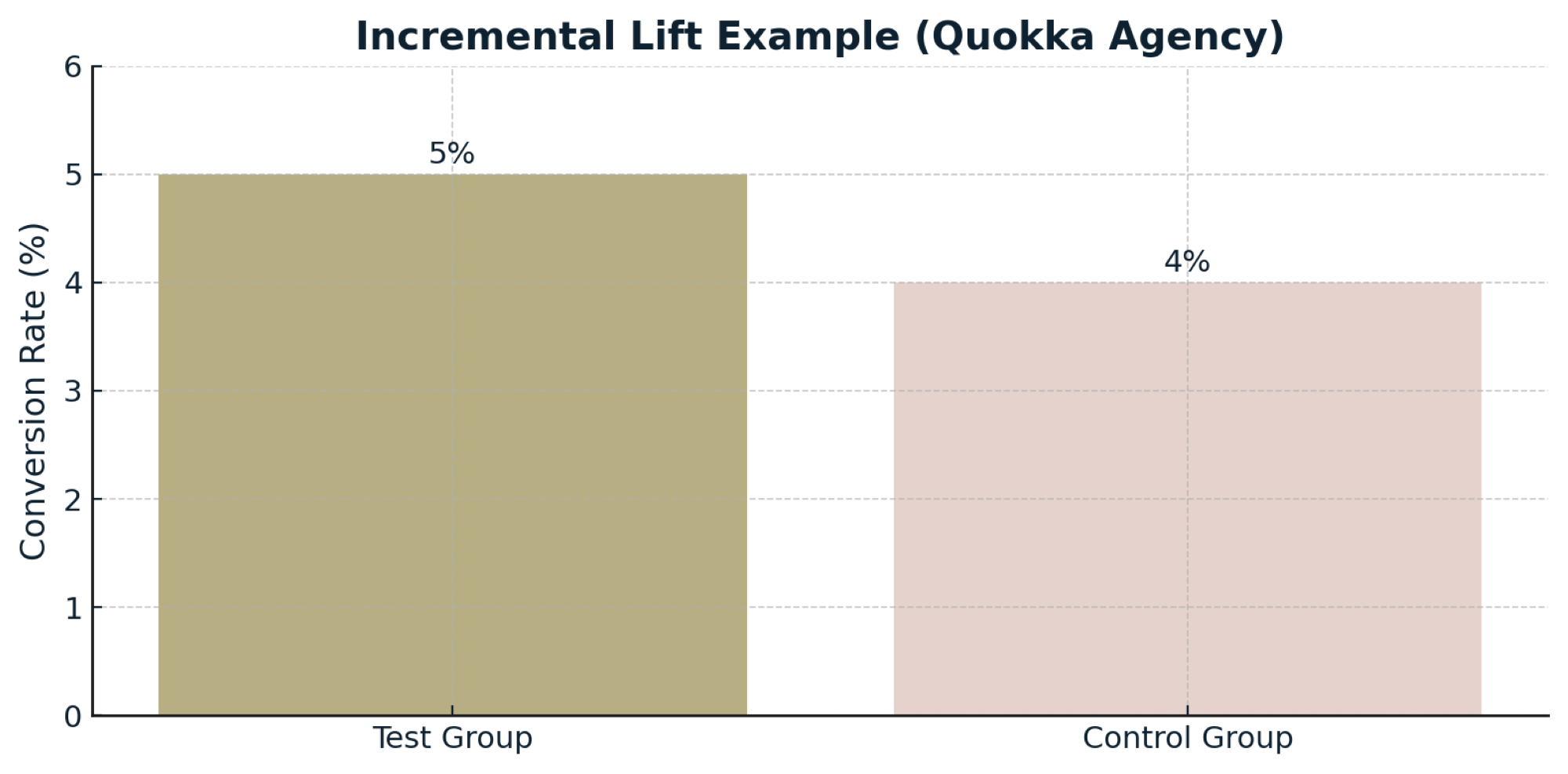
Example: If 5% of people in the test group converted and 4% in the control group did too, your campaign generated a 1% incremental lift.
Incremental vs. Non-Incremental Conversions
Incremental Conversion:
Mary sees a Meta ad for a skincare brand she had never heard of. She clicks, browses, and buys. That ad created new demand. It’s an incremental conversion.
Non-Incremental Conversion
Tom has a pair of trainers in his cart already. He sees a retargeting ad, clicks it, and completes the purchase. He would have bought anyway, so the ad didn’t cause the conversion.
The Grey Area:
Sally is considering buying a new sofa.. She has visited a few websites but has not made a decision. A Meta ad with a time-limited offer nudges her to buy. Did it change her mind or simply speed up a decision she was already going to make? This is where attribution becomes murky, and where incrementality models help.
Econometrics: The Science Behind the Model
Incrementality is rooted in econometrics, the branch of economics that uses statistical techniques to isolate cause and effect.
In marketing, econometrics is often used to understand the impact of advertising on sales — separating the effect of ads from other factors like seasonality, promotions, or natural customer behaviour.
Here’s how the methods Meta uses align with traditional econometrics:
- Randomised Controlled Trials (RCTs): The gold standard for testing causality — one group sees the ad, another does not.
- Synthetic Control Methods: Used when randomisation is not possible; creates a modelled group to act as a baseline.
- Difference-in-Differences (DiD): Compares the changes in outcomes between test and control groups over time.
- Bayesian Modelling: A statistical approach that refines predictions as more data is gathered.
These methods are widely accepted in academic and commercial research, making Meta’s attribution model far more credible than simple touchpoint tracking. It is not about what users clicked. It is about what behaviour your ads changed.
How Meta Measures Incrementality
While it sometimes feels like Zucks has a direct line into people’s heads, Meta cannot see into a user’s alternate reality. But it can use solid statistical methods from econometrics to estimate what would have happened without the ad.
- Controlled Experiments (Conversion Lift): A portion of your audience is held back from seeing the ad (control group). The rest (test group) is shown the ad. The difference in conversions equals the lift.
- Synthetic Control Groups: When a true holdout group is not practical, Meta models a lookalike group based on historical and behavioural data.
- Bayesian Updating: As more data flows in, predictions improve.
These are real methods used in econometrics to measure causality, not just correlation, making Meta’s model far more meaningful than standard in-platform reporting.
How It Compares to Meta’s Other Attribution Models
Meta’s current attribution models were based on timing — primarily focused on when a user clicked or viewed an ad before converting. These include:
| Attribution Model | Type | Credit Logic | Focus | Key Limitation |
| 1-day Click | Rule-based | 100% to the last click within 1 day | Measures short-term intent | Misses delayed or multi-touch paths |
| 7-day Click | Rule-based | 100% to the last click within 7 days | Measures broader attribution | Over-credits long-funnel retargeting |
| 1-day View-through | Rule-based | Credit if ad was viewed (not clicked) within 1 day | Passive exposure tracking | May overstate impact without engagement |
| Incremental Attribution | Experimental | Based on lift vs control group | Measures true ad impact | Requires scale, no touchpoint detail |
Key Difference: Time-based models tell you what happened after someone interacted with an ad. Incrementality tells you what would not have happened without it.
How Will This Impact Advertisers?
Real Campaign Value May Become Clearer
Some campaigns look like top performers under last-click, but incrementality reveals they were not moving the needle.
Expect some surprises when you measure true lift.
Better Budget Allocation
Incrementality lets you identify which campaigns are truly creating net-new value. That means:
- Reducing budget waste on campaigns that do not drive lift.
- Reinvesting in campaigns that actually change outcomes.
Retargeting May Be Re-evaluated
Retargeting often shows great results in last-click models, but under incrementality, it may prove far less effective.
The focus will shift from what is converting to what is causing conversions.
Campaign Optimisation Will Evolve
Instead of chasing low CPAs, advertisers will optimise toward incremental cost per result — the cost of generating one additional conversion beyond what would have happened without the ad.
Marketing Teams Will Need Stronger Measurement Skills
Running incrementality tests and interpreting modelled data requires a new level of analytical thinking. This will become a competitive advantage.
Where do I Find Incremental Attribution Settings on Meta Ads?
Attribution settings as set under the conversion event when creating your campaign. See video below
Words of caution
While you’re now thinking “this is the answer we’ve been praying for”… Meta’s incrementality model does offer valuable insight but isn’t a silver bullet
While Meta’s incrementality model offers valuable insight, it is not a silver bullet.
Limitations to be aware of:
- Requires volume: Without sufficient conversions, your test and control groups may not deliver statistically significant results.
- Campaign-level, not touchpoint-level: You will not get a breakdown of what specific ads or creatives worked best. It is holistic.
- Black box modelling: You are trusting Meta’s methodology, and you cannot inspect the raw data or model logic.
- Takes time: Incrementality insights build up over time. You will not get instant feedback the way you do with CPA or CTR.
Situations where it may not be suitable:
- Niche or low-volume advertisers: If your budget or audience size is small, there may not be enough data to run a meaningful test.
- Very short-term or flash-sale campaigns: These typically rely on immediate attribution and may not benefit from long-term lift modelling.
- Non-conversion-focused campaigns: If your goals are engagement, awareness, or reach, this isn’t the right model at the moment.
That does not mean you should not try. Just approach the results with context and caution.
Does Incremental Attribution work for high ticket low volume sales?
If your business sells high-value products or services with long sales cycles and relatively few conversions, such as luxury items, B2B services, or high-ticket consultancies, the incrementality model may not produce meaningful insights on its own. That is because:
Conversion volumes may be too low for statistical significance.
The full buying journey may span weeks or months, often with multiple touchpoints across channels (online and offline).
Meta can only measure what happens within its platform, so complex, high-consideration journeys can be underrepresented.
In these cases, incrementality should be treated as one tool in a broader measurement strategy, ideally alongside CRM integration, offline tracking, or even media mix modelling to understand long-term brand impact.
What About Seasonal Fluctuations?
One of the strengths of Meta’s incrementality model is its ability to account for seasonality. Because test and control groups are run concurrently, both are exposed to the same external market conditions, including seasonal demand spikes such as Black Friday, Christmas, or industry-specific peaks.
This means the model compares like-for-like behaviour in real time, isolating the difference made by the ads themselves — not by the seasonal environment. If 5% of the test group converts during a busy period, and only 4% of the control group does, that lift is still attributed to the campaign, even within the seasonal context.
However, advertisers should remain cautious:
If there are major pricing changes, promotions, or campaign overlaps happening simultaneously, those can affect results.
It’s still essential to interpret results in context — incrementality measures ad impact, not necessarily promotion or brand awareness effects.
What About Lead Generation Campaigns?
Meta’s incrementality model is not limited to purchases. It works for lead generation campaigns too, as long as you have a clearly defined conversion point (like a form submission or lead ad completion).
Why it can work:
Leads are still considered conversions in Meta’s system.
You can measure lift in lead volume the same way as you would with sales.
It helps identify whether your campaign is generating net new leads, not just capturing people who would have enquired anyway.
Caveats:
Meta tracks the lead, not what happens next. So if lead quality varies, you will need to connect Meta with your CRM or sales data to assess actual value.
If there is a long gap between lead generation and conversion, it might be harder to assess full impact within Meta’s attribution window.
That said, if you are running high-volume lead generation campaigns, for example in education, recruitment, or service-based businesses, this model can offer strong insight into which campaigns are genuinely effective.
So, Do We All Need to Be Econometricians Now?
Thankfully, no. You do not need a PhD in econometrics to use Meta’s incrementality model effectively, but you do need to understand the basic principles behind it. The power of the model lies in how it simplifies complex statistical methods into usable insights for marketers.
However, having a solid grasp of concepts like test/control groups, lift, and statistical significance can help you interpret results more confidently and make smarter decisions.
What is more important than doing the maths yourself is knowing when to trust the results and when to dig deeper. Partnering with a performance marketing agency, or using tools that can support structured testing and performance interpretation will give you the edge, without needing to build models from scratch.
Meta’s new incrementality attribution model marks a potential new dawn in how we measure success. Instead of rewarding clicks and impressions alone, it challenges advertisers to ask the bigger question: Did we make a difference?
This model is not perfect. It is probabilistic, modelled, and lacks user-level granularity. But in a privacy-first, signal-poor landscape, it is a far more reliable way to measure true advertising impact.